Changelog

  1. Two ways to flatten the Kosmos, and a link for every figure

    A sixth figure shows Wilber's distinction between gross reductionism (everything to atoms) and subtle reductionism (every interior collapsed into the exterior system), the move he blames for "flatland". It's on Visuals and heads the Flatland page. Every figure now also has its own page and a Copy link button, so a shared link previews that figure.
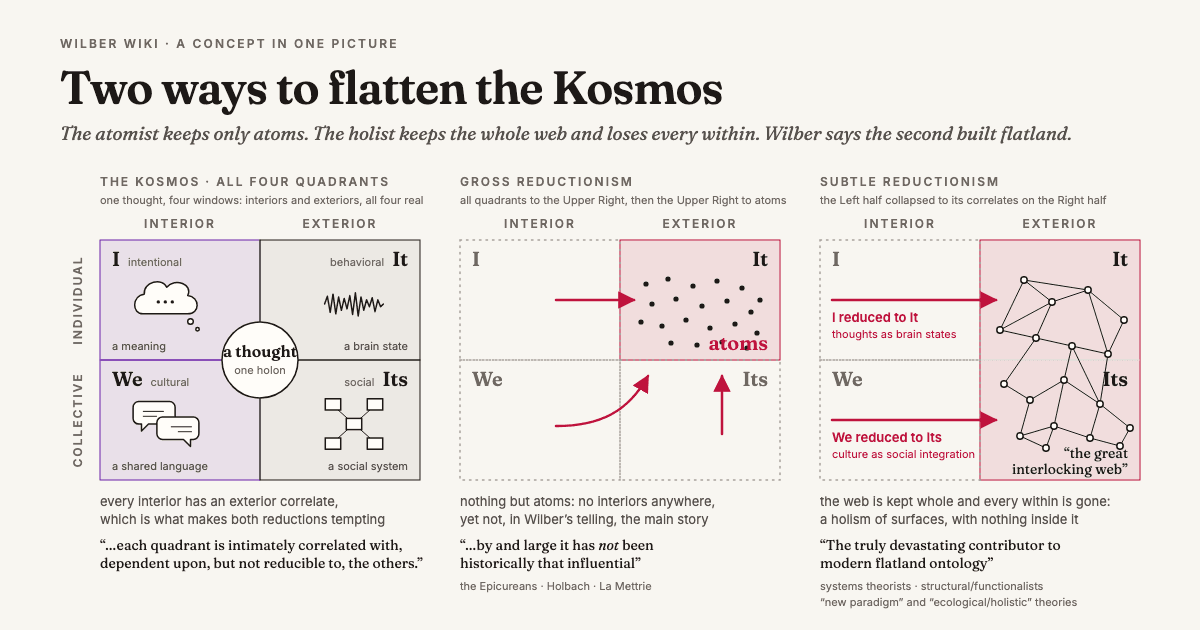
    Two ways to flatten the Kosmos
  2. Wilber's books on one line

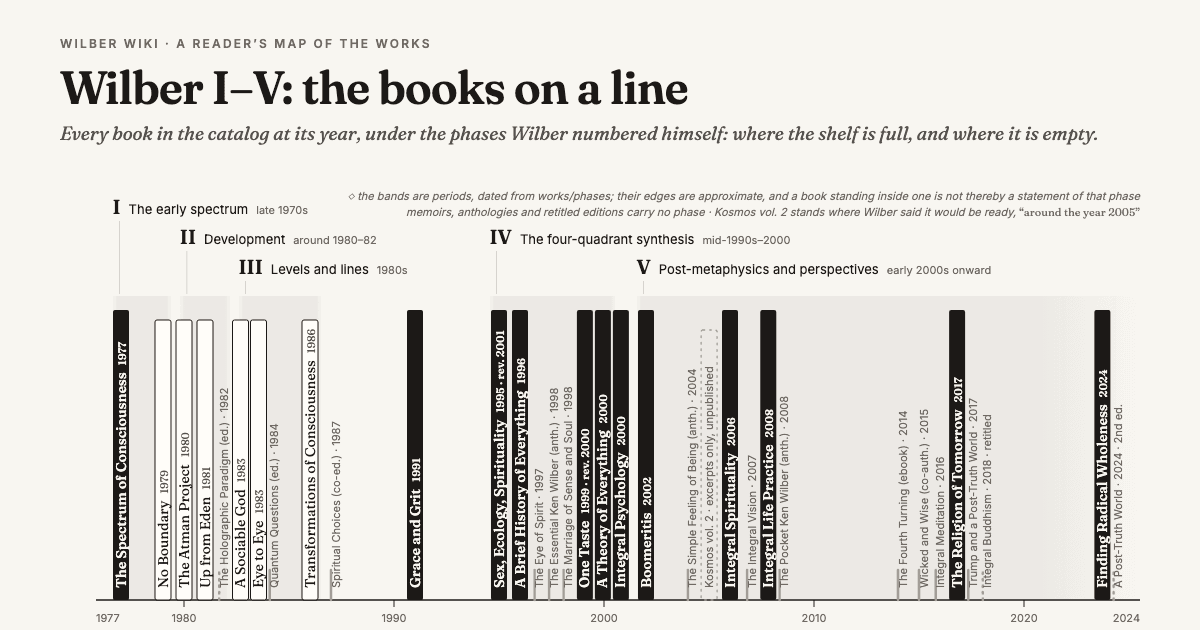
    A new figure puts every book in the catalog on one to-scale timeline, under the five phases of Wilber's thinking: the crowded shelf from Sex, Ecology, Spirituality onward and the near-empty years before it show at a glance. It's on Visuals and heads The evolution of Wilber's thought.

    Wilber I–V: the books on a line
  3. Two more figures: the four quadrants and holarchy

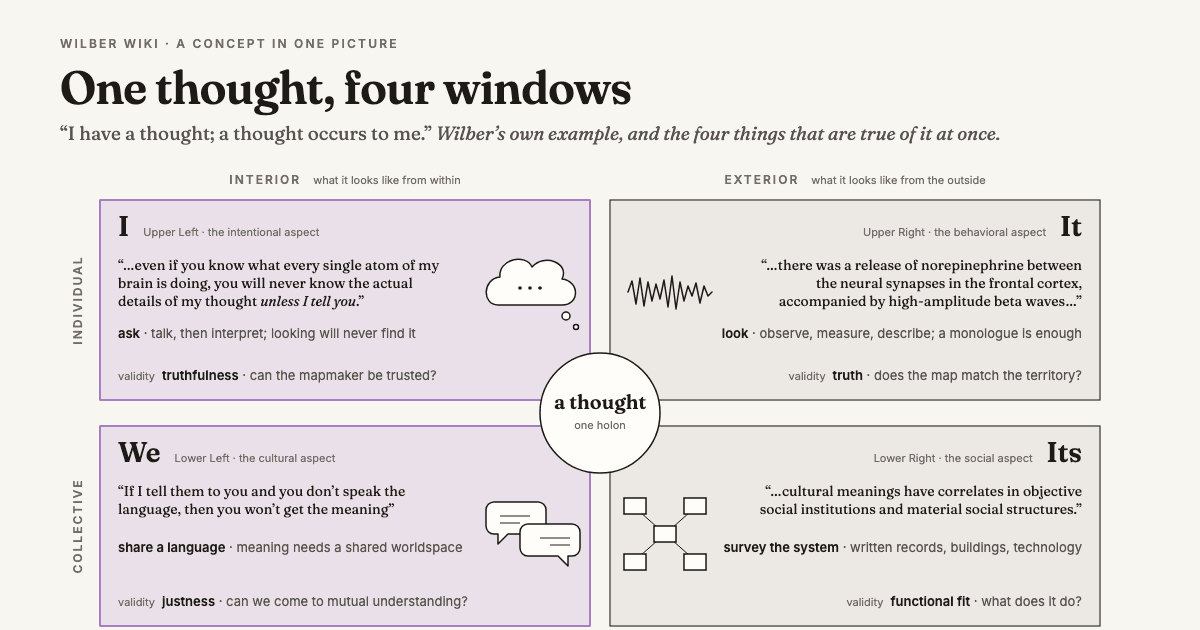
    Visuals now has four figures. One thought, four windows follows Wilber's own example of a single thought round the four quadrants. Pull a rung out acts out his test for what is "higher": destroy the molecules, and cells and organisms go with them. Each figure now also heads its concept page: the pre/trans fallacy, the four quadrants, holarchy and from SES to Integral Spirituality.

    One thought, four windows
  4. Wilber's ideas in one picture

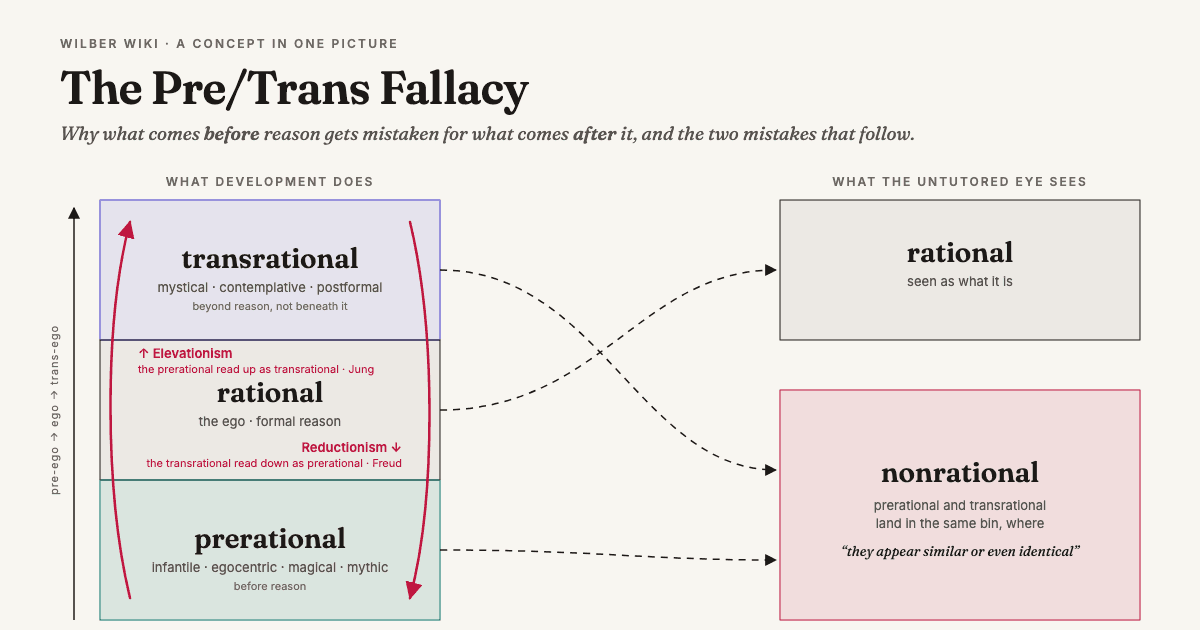
    A new Visuals page holds diagrams that each make one of Wilber's ideas click, signed so they can be shared. The first two are the pre/trans fallacy and how Wilber took mystical states off the developmental ladder between Integral Psychology and Integral Spirituality. Both are redrawn from his descriptions, with verbatim quotes and sources. Each shows as an image you can copy, download or share with one click, and you can watch the idea build step by step.

    The pre/trans fallacy diagram
  5. Full summaries of three key books

    Sex, Ecology, Spirituality, Integral Psychology and Integral Spirituality each now have a full summary page: a short introduction and context, a summary of the main argument, a part-by-part overview citing chapters and endnotes, key passages in Wilber's own words, what's contested, and links to the related concepts and people. Each page was written from the book's full text and checked against it by a second, independent reader.

  6. How Wilber's map changed, from SES to Integral Spirituality

    New concept page, From SES to Integral Spirituality, traces three shifts across Sex, Ecology, Spirituality, Integral Psychology and Integral Spirituality: the Great Chain narrowed to a map of one quadrant, its levels recast from given to evolved, and higher states taken off the developmental ladder. Each shift is shown in Wilber's own words from all three books, and the page notes where the change is more continuous than his later accounts suggest.

    Every excerpt's source line now links to the book's page. The pre/trans-fallacy page notes where the idea first appeared as an essay (ReVision, 1980). The works catalog is now books only, without audio sets, course kits and other minor items.

    Five existing concept pages (four quadrants, waves and streams, the psychic/subtle/causal/nondual, postmodernism, and the five definitions of spirituality) now include passages from Integral Spirituality showing how Wilber later revised them. The changelog is now in the site menu.

  7. Choosing what to read

    Added a selective reading guide and a guide to Wilber's five phases and the Kosmos trilogy. The chronological catalog now distinguishes retitled editions and reused material, with corrected publication details and clearer notes where the evidence remains uncertain.

    Simplified the People and Concepts introductions to make the indexes easier to browse.

  8. A roadmap through Wilber's ideas

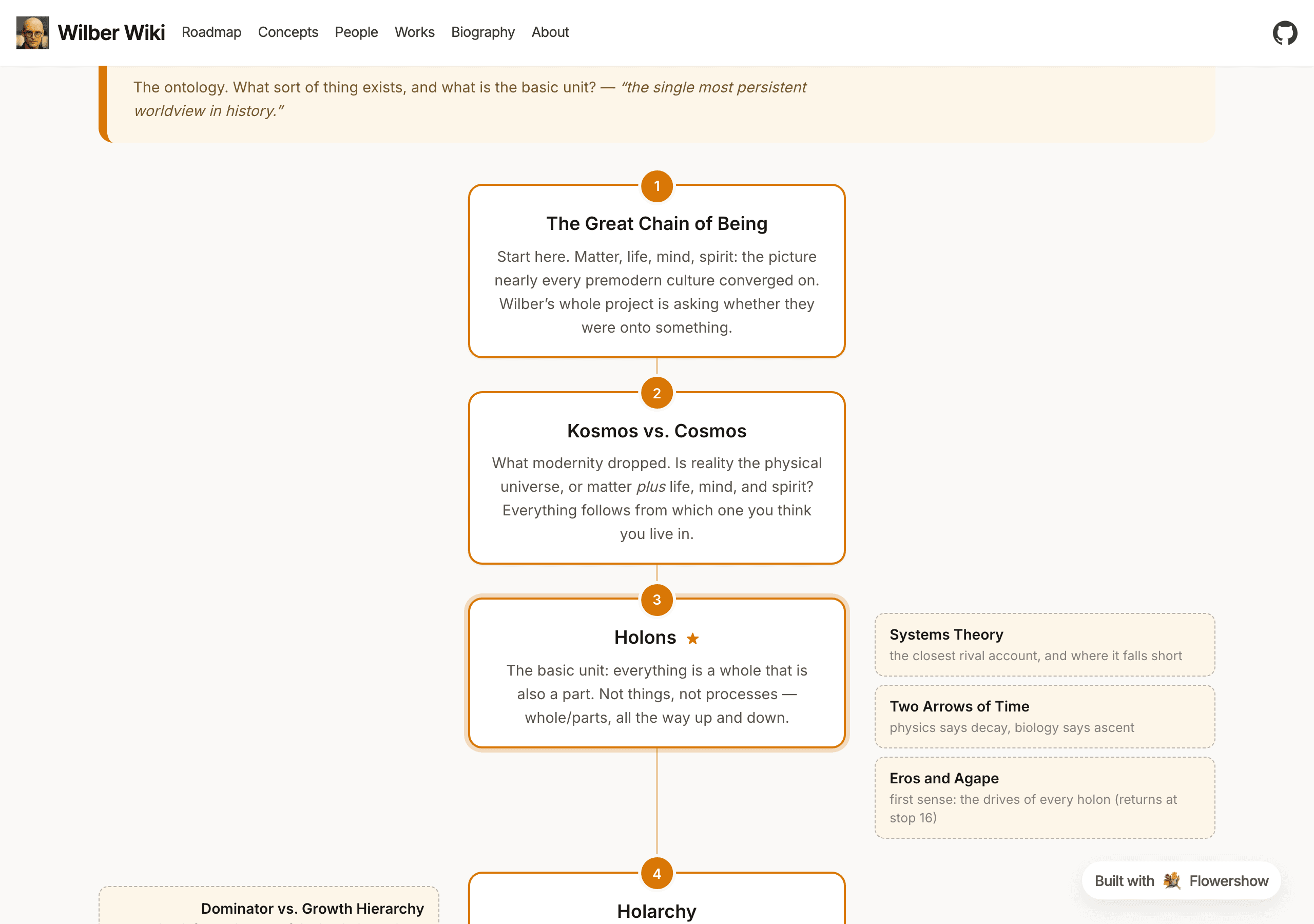
    All 41 concepts now sit on a single visual reading path: four acts, nineteen numbered stops down a central spine, with optional side branches for depth and counterargument. There are two ways in — start at the top if you are new, or jump straight to a topic if you came looking for one — plus a six-stop express route for anyone with only an afternoon, and a panel pointing at the places Wilber's argument is most contested. See the roadmap.

    The roadmap's central spine, with numbered stops and side branches
  9. New concept page: The Myth of Primal Ecological Wisdom

    Added The Myth of Primal Ecological Wisdom, on Wilber's argument that the Eco-Romantic claim that tribal societies possessed a lost "ecological wisdom" confuses indissociation (nature not yet differentiated from mind) with integration, and that pre-modern peoples did real ecological damage too — limited by means, not restrained by wisdom. Cross-linked with the pre/trans fallacy, environmental ethics, and the dialectic of progress.

  10. Excerpts now shown directly, and a full accuracy pass

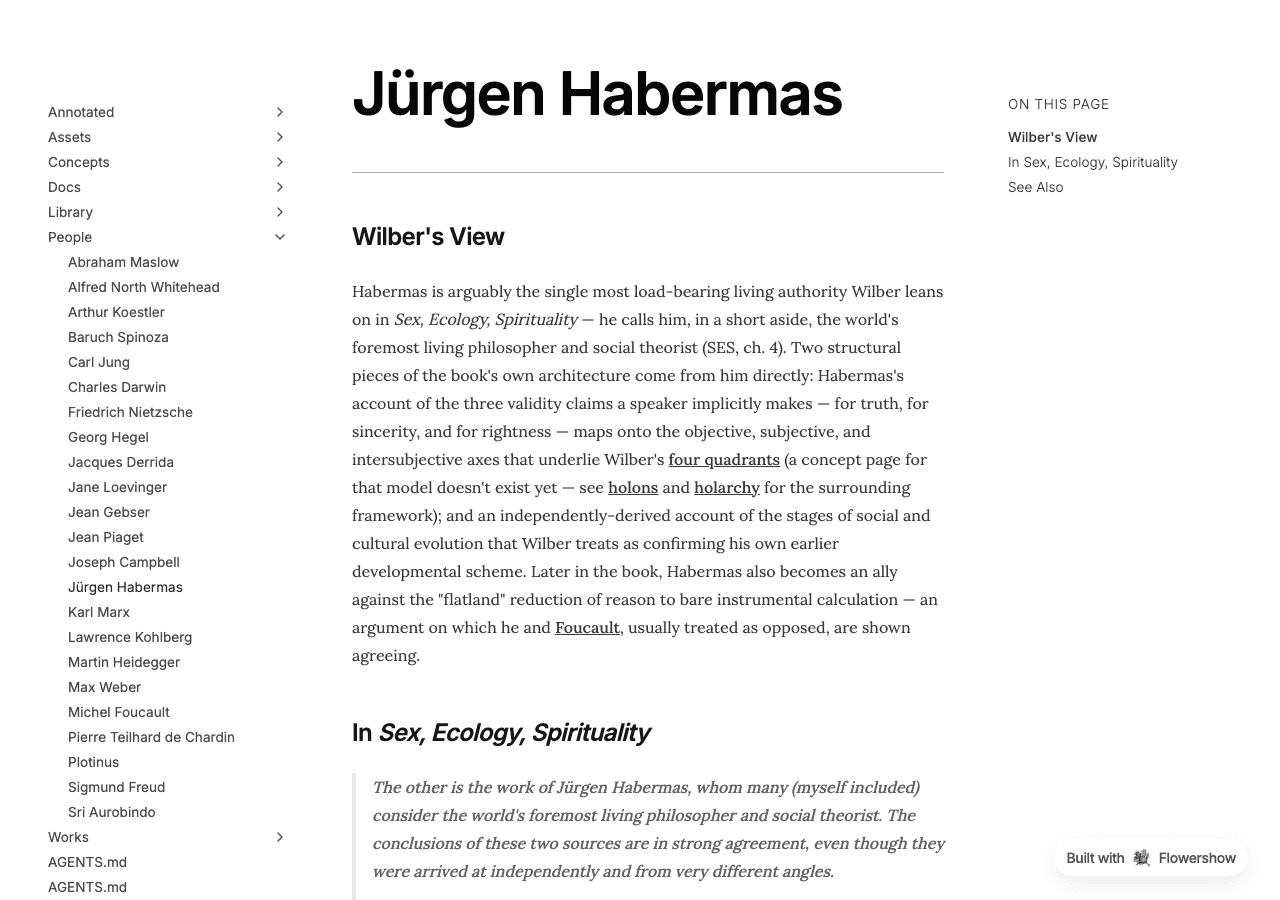
    The click-to-expand style used for excerpt quotes is gone — every quote across the concept wiki and people index now shows in full, directly on the page. That prompted a proper editorial review of all 182 excerpts against the source book, which turned up and fixed a real problem: one page's only "quote" was actually a paraphrase, not real text. Also fixed: a quote that broke off mid-sentence, several mislabeled chapter citations, and a handful of pages that were more one-sided or redundant than the book itself is. See Jürgen Habermas for the clearest before/after.

    The Habermas page with quotes shown directly, no accordion
  11. Annotatable reading layer: Phase 1 prototype

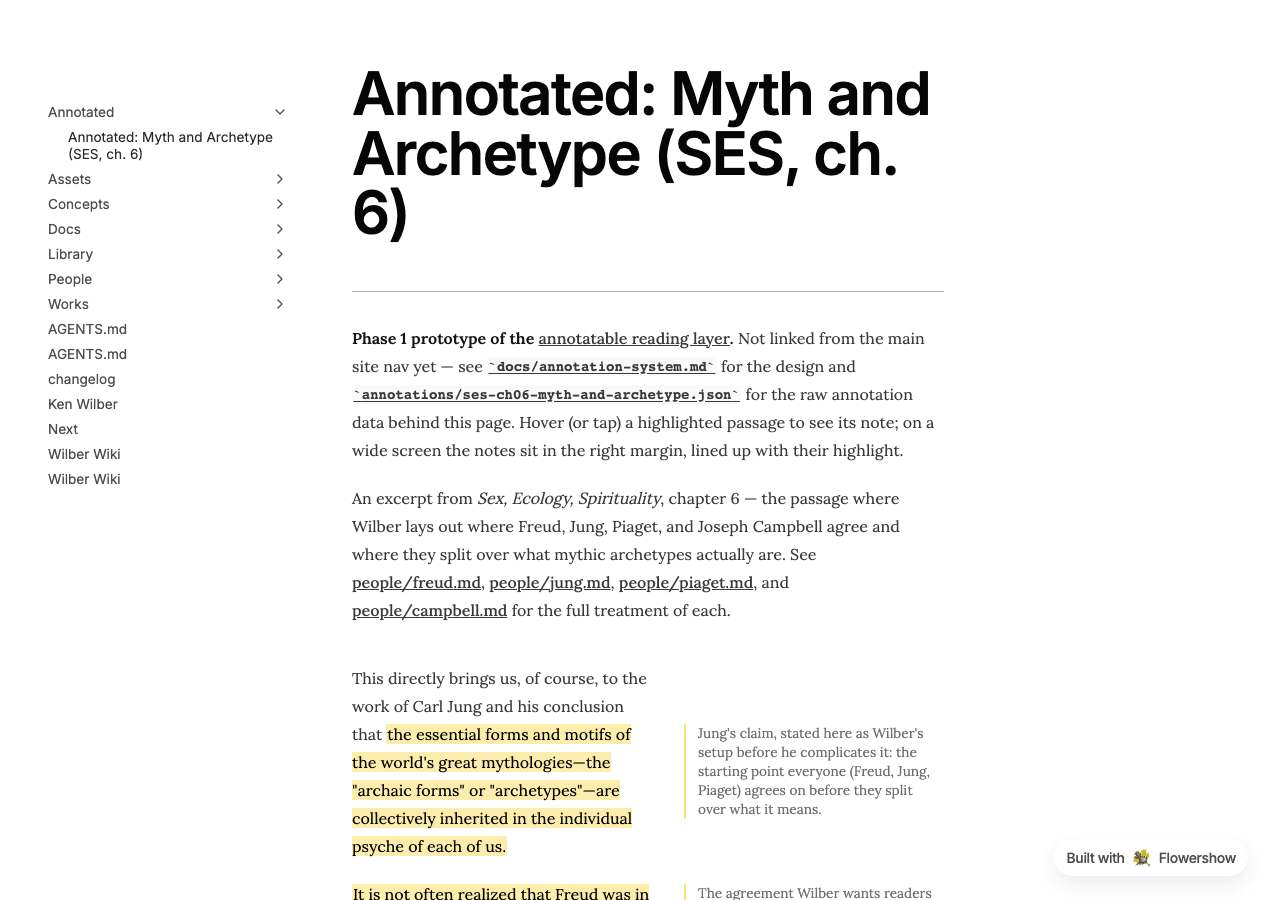
    A first working prototype of annotated book text: an excerpt of Sex, Ecology, Spirituality renders with highlighted passages and margin notes attached directly to them, à la Google Docs comments. One chapter section for now, not yet linked from the site's navigation — proof of the mechanism before it's built out further. See it live: Annotated: Myth and Archetype.

    Highlighted passage with a margin sidenote on the annotated reading prototype
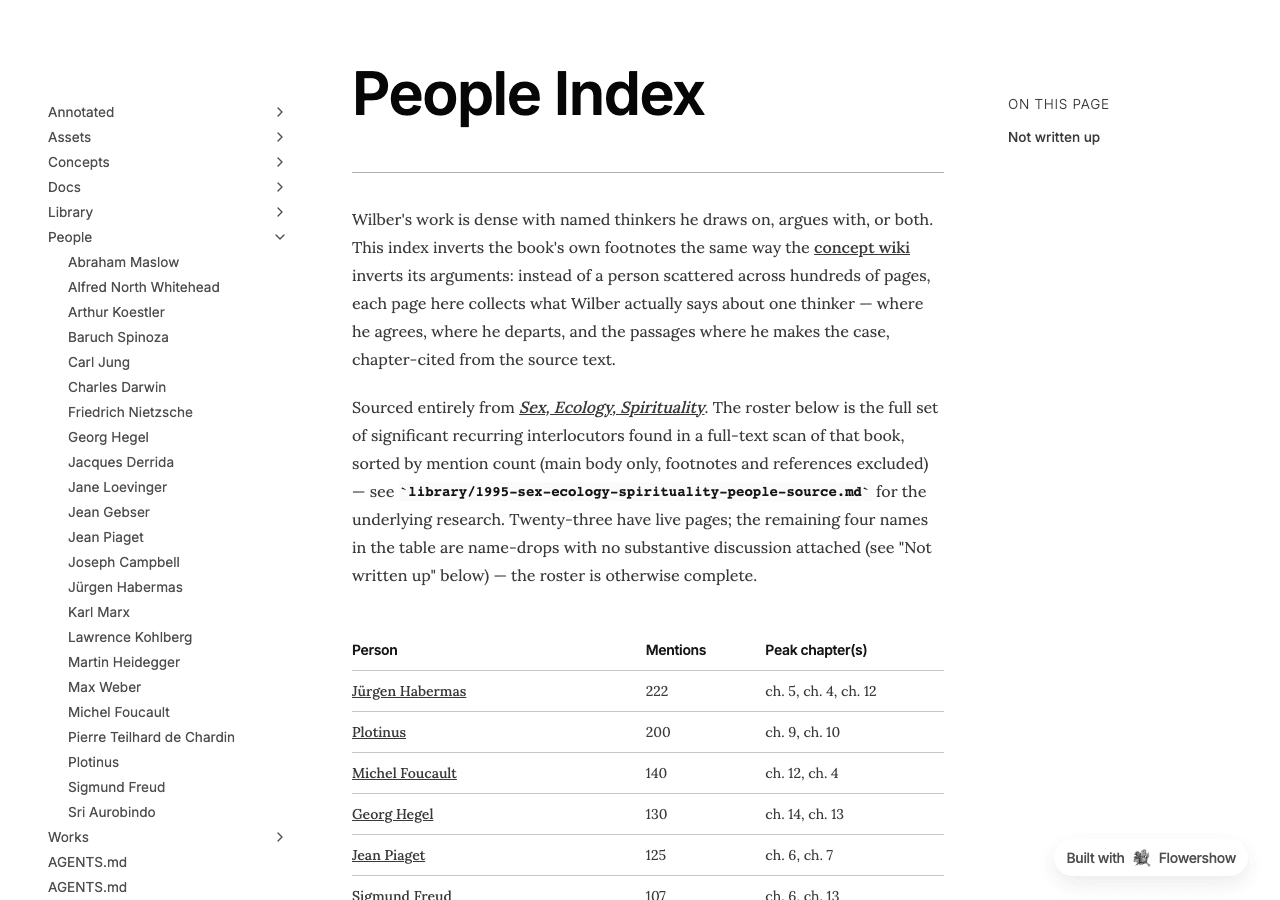
  12. People index: 23 thinkers Wilber engages with

    The people index is now substantially built out — Habermas, Plotinus, Foucault, Hegel, Piaget, Freud, Jung, Joseph Campbell, Gebser, Spinoza, Whitehead, Marx, Aurobindo, Kohlberg, Loevinger, Maslow, Koestler, Derrida, Heidegger, Darwin, Nietzsche, Weber, and Teilhard de Chardin each get a page showing where Wilber agrees with them, where he breaks from them, and the passages where he makes his case. Browse the People Index.

    The People Index page listing thinkers by mention count
  13. Concept wiki: ten more concepts, now sourced from the full book text

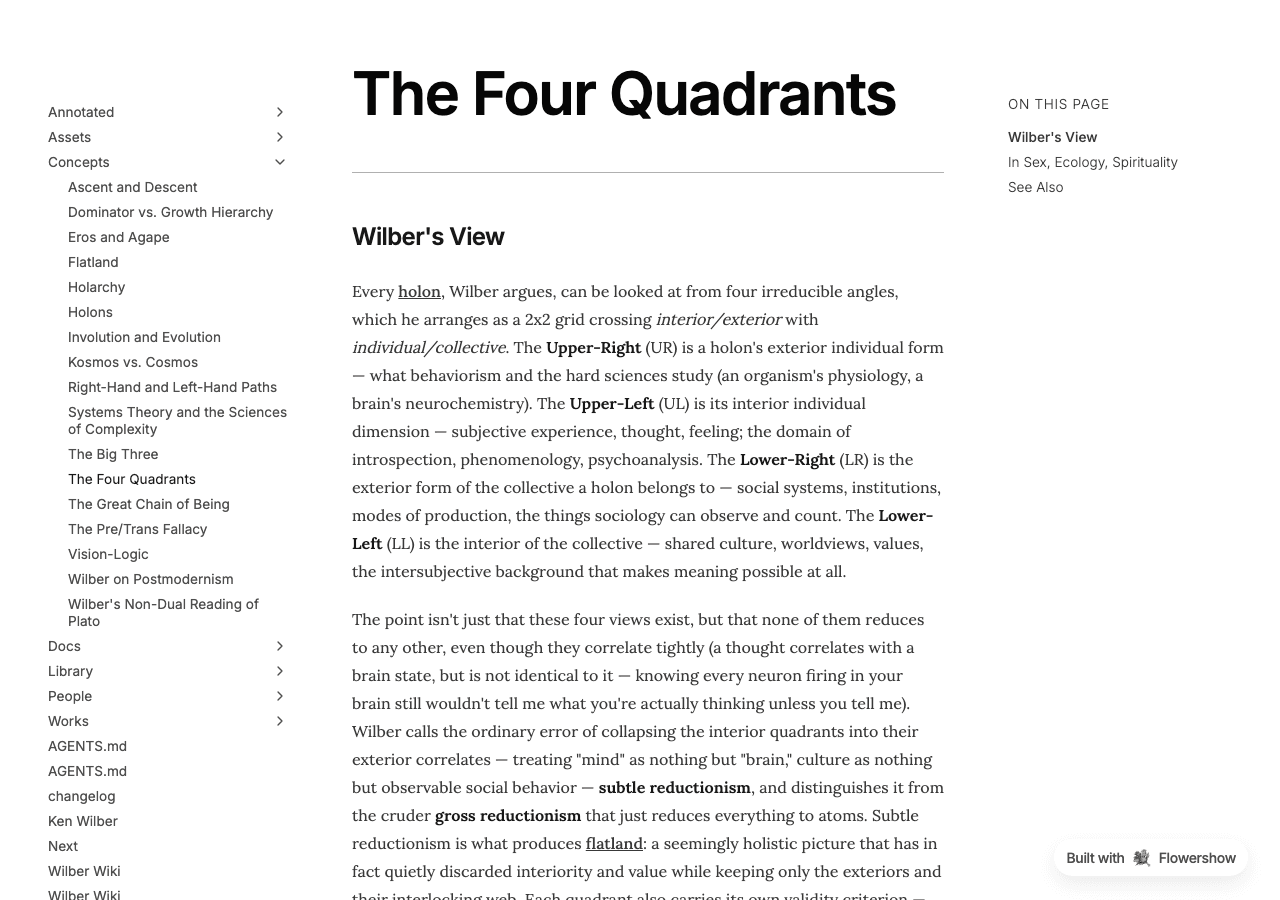
    The concept wiki grows from seven pages to seventeen — the four quadrants, the Big Three, the pre/trans fallacy, vision-logic, flatland, Kosmos vs. cosmos, Eros and Agape, the Right-Hand and Left-Hand paths, involution and evolution, and Wilber's take on postmodernism — all newly sourced directly from the book's full text rather than reading notes. Example: The Four Quadrants.

    The Four Quadrants concept page
  14. Concept wiki pilot: seven concept pages sourced from Sex, Ecology, Spirituality

    The first working piece of the concept wiki: instead of an idea Wilber discusses being scattered across a dense book, each concept — holons, holarchy, dominator vs. growth hierarchy, the Great Chain of Being, systems theory, ascent and descent, and his reading of Plato — now gets its own page pairing a synthesis of his view with expandable excerpts pulled straight from the source text. Example: Holons.

  15. Bio, full works catalog, and cover art

    Booted up the project: a draft biography of Ken Wilber, a complete works list (39 titles across five decades) with a dedicated page per book, cover art for most of them, and in-depth overviews for the twelve core works. See the Biography and Works Catalog.

Built with LogoFlowershow